
This one is about reactivity: dogs that react to other dogs, and dogs that react to people. I’m not talking about prey drive. To me, that isn’t reactivity.
Why is my dog reactive?
There are two things the majority of people seem to be unaware of. The first is that a lot of reactivity is genetic. One or both of the parents are anxious of dogs or people, and the puppy is born with it. This is super common.
The second is that reactivity is all fear-based. In most cases, the dog does not want to hurt what it’s reacting to. A dog that’s reactive to other dogs barks and lunges, but it does not want to make physical contact. It just wants to show the other dog that it’s super nervous.
If it were safe to drop the leash, in most cases you would actually have a calmer dog. We hold and pull, thinking we’re stopping our dog from hurting the other dog. What we’re really doing is fighting it physically, which makes the behaviour worse.
You’ll notice that most of the dogs yours barks at don’t try to defend themselves, because they understand what the behaviour is. If the other dog barks and lunges back, now you have two anxious dogs. One is saying, “Hey, I’m nervous,” and the other is saying the same thing back.
What should I do if a reactive dog barks at me?
With people it’s very similar. The dog doesn’t want confrontation or contact with the person. In the majority of cases, if the person stands still and doesn’t move towards the dog, the person is going to be very safe, and the dog will eventually relax.
Where people go wrong is one of two ways. Either they panic, which triggers a bigger fear response. Or they try to befriend the dog: they reach out to get it to sniff them, or try to hand it a treat. That is the opposite of what the dog wants. The dog wants some space. The dog wants to feel safe.
The best thing is to ignore the dog as best you can. Don’t face it, because that feels confrontational. Don’t make eye contact. Don’t talk to it. What it really wants is for you to go away.
How do I stop my dog barking and lunging at other dogs?
When another dog or a person seems confrontational to your dog, it’s going to go into the old behaviour: the lunge and the bark. That’s when it’s our job to correct the dog, in the moment, to help it relax.
Technically, that’s what we want. We want the old behaviour to show up so we can teach the dog it’s unnecessary. When people react, we can realize later that we made a mistake and try to be different next time. A dog is never going to think, “Oh, I didn’t have to do that, I was actually safe.” So the help has to happen in the moment.
As your dog comes back to calm, it has a chance to recognize that this isn’t a threat. You’re making it very clear that you disagree with the behaviour, but you still love the dog. How the correction itself works is on my reactivity training page.
It’s the same restraint we have walking down the sidewalk. We don’t agree with or appreciate everyone we pass, but we don’t lash out. We’re creating that for the dog as well.
If you’re doing things really well, a dog that reacts to other dogs can change as quickly as two weeks. Dogs that react to people take a little longer, and elevators take the longest. The key is meeting the majority of challenges. If you don’t, you’ll improve your dog, but you’ll always have an issue. And no dog is perfect forever, any more than any person can be. You keep up the odd reminder so you don’t get regression.
This timing is most of what the first session teaches.
How do I walk a reactive dog past another dog?
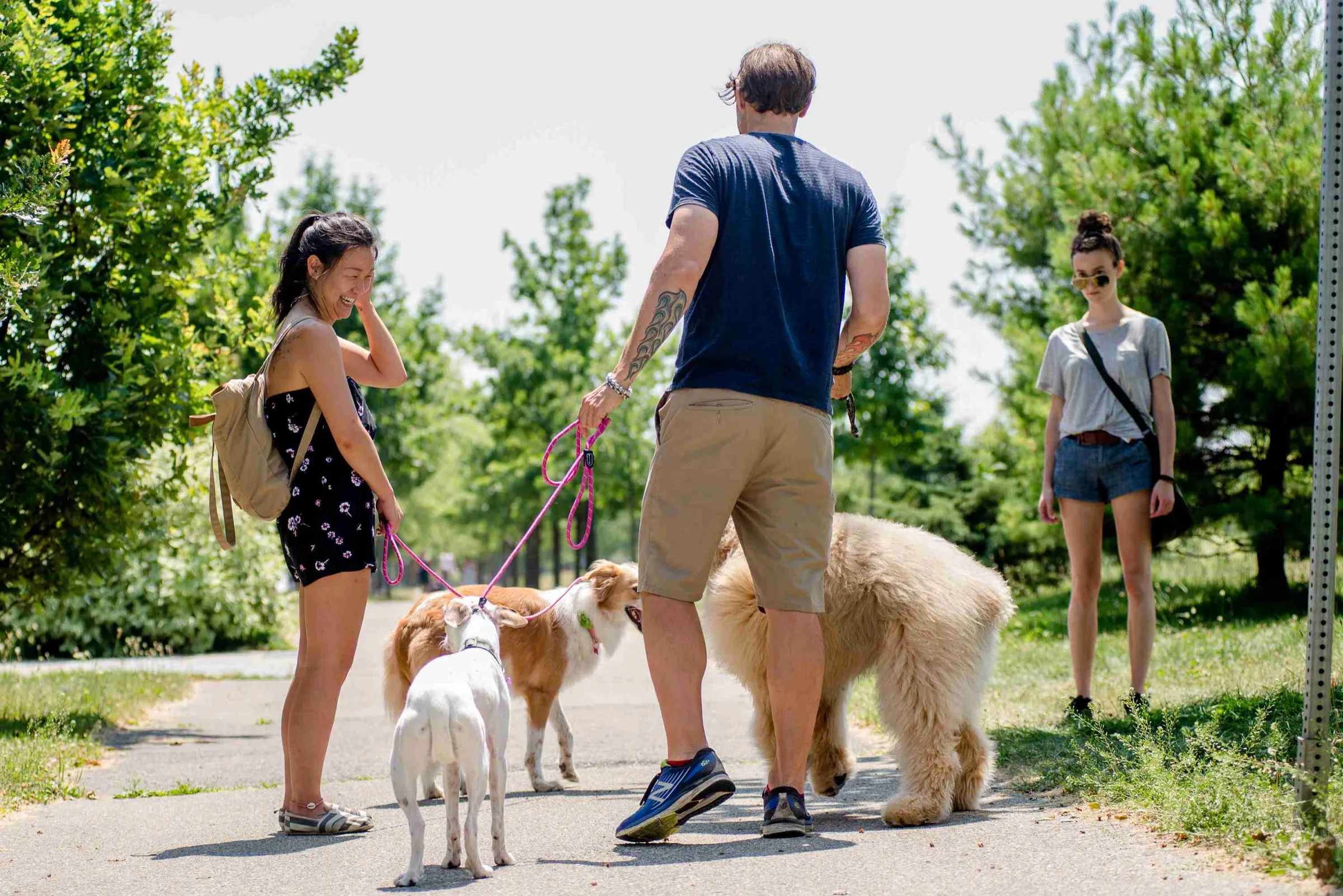
When you’re walking towards a dog or person your dog may react to, move your dog to the opposite side. Now you’re a physical barrier between them. Your dog doesn’t get the same eye contact, and that takes away a lot of the threat in your dog’s eyes. This is mostly for the early stages. Once you’re hardly correcting at all, you won’t need to.
How do I get a reactive dog through an elevator?
Elevators are probably the most difficult thing for every owner. An elevator is practically a jack-in-the-box. Every time the door opens, your dog is waiting to see what comes in, and there’s nowhere for it to go. All your dog can think about is the other dog in there with it.
So place yourself in front of your dog. Corner it in the L shape at the back of the elevator, with one leg in front of it and the other to your side: one foot forward, one foot back. That blocks some of the eye contact. Stay relaxed, and correct early, before your dog gets so overwhelmed that nothing will change it until you get out. More than a few floors is a long time to control a dog that’s losing it.
Do treats or affection help a reactive dog?
Food and treats can’t work, because a dog that is too stressed can’t pay attention to the food. Toys are the same. So is love and affection. If love and affection worked, all our dogs would be fine and we’d have no reactivity.
If anything, affection is the last thing you want to give in those moments. When you tell a nervous dog it’s okay, or pet it as it’s getting ready to react, you’re rewarding it for feeling nervous. You’re telling it you agree with the nervousness.
The other mistake I see is asking a reactive dog to sit or lie down while another dog or person approaches. It can hold that for a little while, but the closer they get, the more terrified your dog is getting. At a certain point it loses it, because it was never going to be calm in that situation in the first place.
The best thing you can do is keep walking as calmly as possible and correct as needed. If you’re missing the timing and getting too close, you may have to cross the street. But only because of our mistakes. Otherwise, passing is the easiest choice, because any anxious dog has a much harder time being still than moving.
Should my reactive dog wear a muzzle?
Most of the time, these dogs don’t want to make physical contact. But if they get overwhelmed enough, and we make enough mistakes, bites can happen. The majority of dogs go into avoidance or freezing. Some choose biting, and that ups the ante.
In some of those cases you may need a muzzle, just until you’ve helped your dog change. That keeps everyone safe, including your dog, so you don’t end up with a bite order and then a muzzle order for life. The muzzle doesn’t help the behaviour. It just means nobody gets hurt in the meantime.
I don’t like using muzzles. Put one on a nervous dog and in most cases it gets a little more nervous, because its last defence has been taken away. So you really have to need it. If your dog wouldn’t consider biting in 99% of cases, don’t use one. It’s like asking people to wear handcuffs to go for a walk when they’re not dangerous.
Whose job this is
The thing we forget is that it’s our job to help these dogs. Most of them were born nervous. As frustrating as reactivity is for us, it’s way more terrifying for the dog. It really believes the fear is real.
And until you’ve helped your dog, it’s your job to get out of people’s way in public. Don’t make it everyone else’s problem. Even if your dog isn’t going to hurt anyone, it is going to scare most people. That isn’t fair to them.
Give as much space as you can. It doesn’t hurt to say, “Sorry, my dog’s really reactive, but they’re not aggressive. They’re probably going to bark and lunge,” so people can be a bit prepared. And don’t give your dog four, six or eight feet of leash to get close to people. It’s our responsibility to make sure the people around a reactive dog can feel safe too.